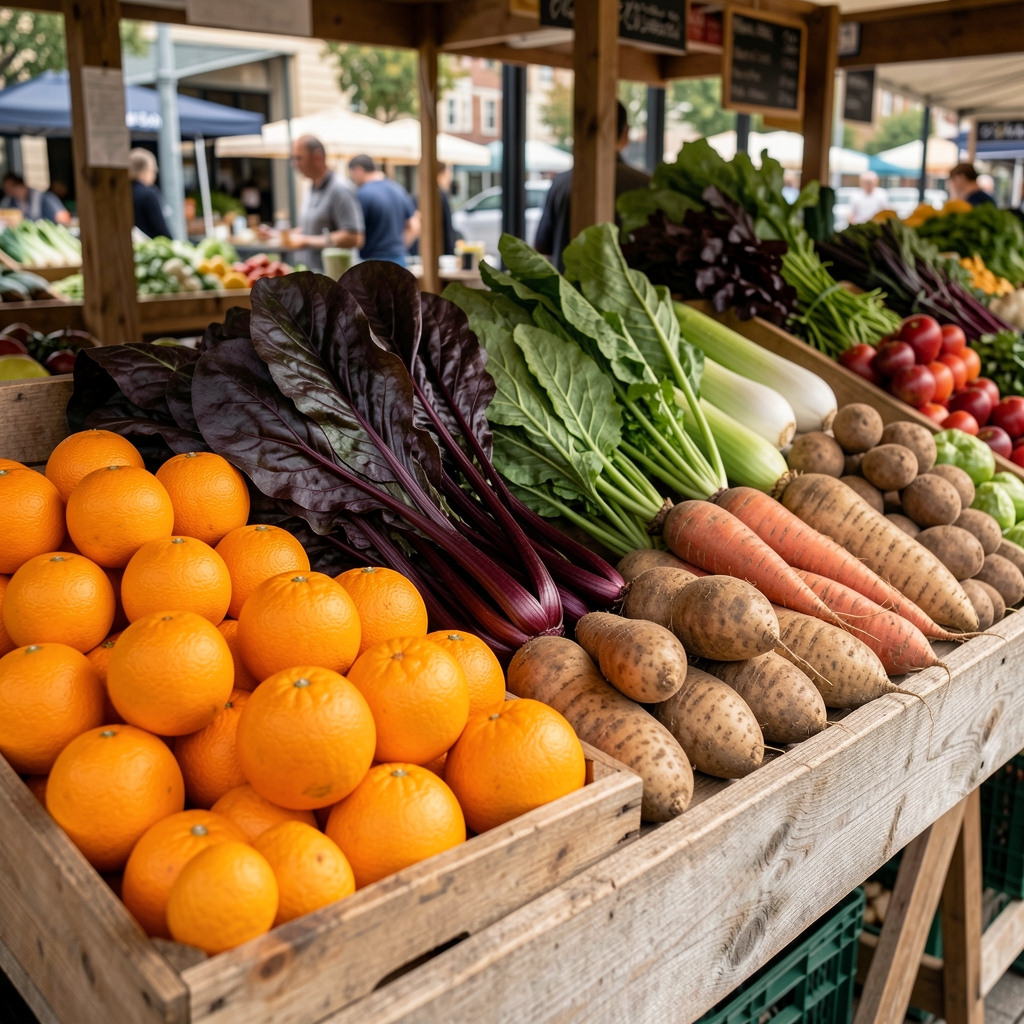
The calendar is, among other things, a nutritional document. The vegetables and fruits that become available in each season are not random — they reflect the accumulated logic of growing cycles shaped over centuries, producing, in each quarter of the year, a distinct set of flavours, textures, and nutritional characteristics.
What Seasonality Actually Means for the Everyday Cook
In the context of a British calendar, seasonal eating is not a rigid philosophy — it is an orientation. It means that in January, when root vegetables are at their peak and dark leafy brassicas are abundant and inexpensive, those are the materials of the kitchen. In July, the same kitchen shifts toward stone fruits, tomatoes, courgettes, and fresh beans. The cook who notices this shift and works with it will, almost incidentally, eat with more variety across the year than one who reaches for the same dozen items regardless of month.
Nutritional variety across the year is not a minor benefit. Published dietary research consistently identifies dietary diversity — measured by the number of distinct plant foods consumed in a week — as a meaningful indicator of gut health. The gut microbiome, which plays a documented role in digestive function, energy regulation, and overall wellbeing, is supported by a wide range of plant-based inputs, each contributing different types of fibre and phytonutrients.
Seasonal eating, by its nature, produces this diversity. The cook who uses what the season offers will rotate through a considerably wider range of plants across twelve months than one working from a fixed repertoire of year-round supermarket staples.
"The market stall in March looks quite different from the one in October. Both are abundant. The difference is the kind of abundance — and that difference, used well, is a nutritional asset."
Tobias Ashcroft — Gralev Letters, March 2026
The British Seasonal Calendar as a Nutritional Framework
The United Kingdom has a growing season that, despite its northern latitude, offers genuine abundance for roughly ten months of the year. Only the deep winter months (December and January) present a narrower range of fresh domestic produce — and even then, root vegetables, kale, leeks, and stored apples and pears provide a nutritionally solid base.
Parsnip, celeriac, swede, beetroot, kale, Brussels sprouts, leek, Savoy cabbage, stored apple and pear. Dense, fibrous, warming — suited to long preparation.
Purple sprouting broccoli, spinach, asparagus, spring onion, watercress, radish, pea shoots, early strawberry. Light, quick-cooking, high in folate and vitamin C.
Courgette, tomato, cucumber, broad bean, runner bean, fresh pea, lettuce varieties, stone fruit, berries. High water content, antioxidant-rich phytonutrients.
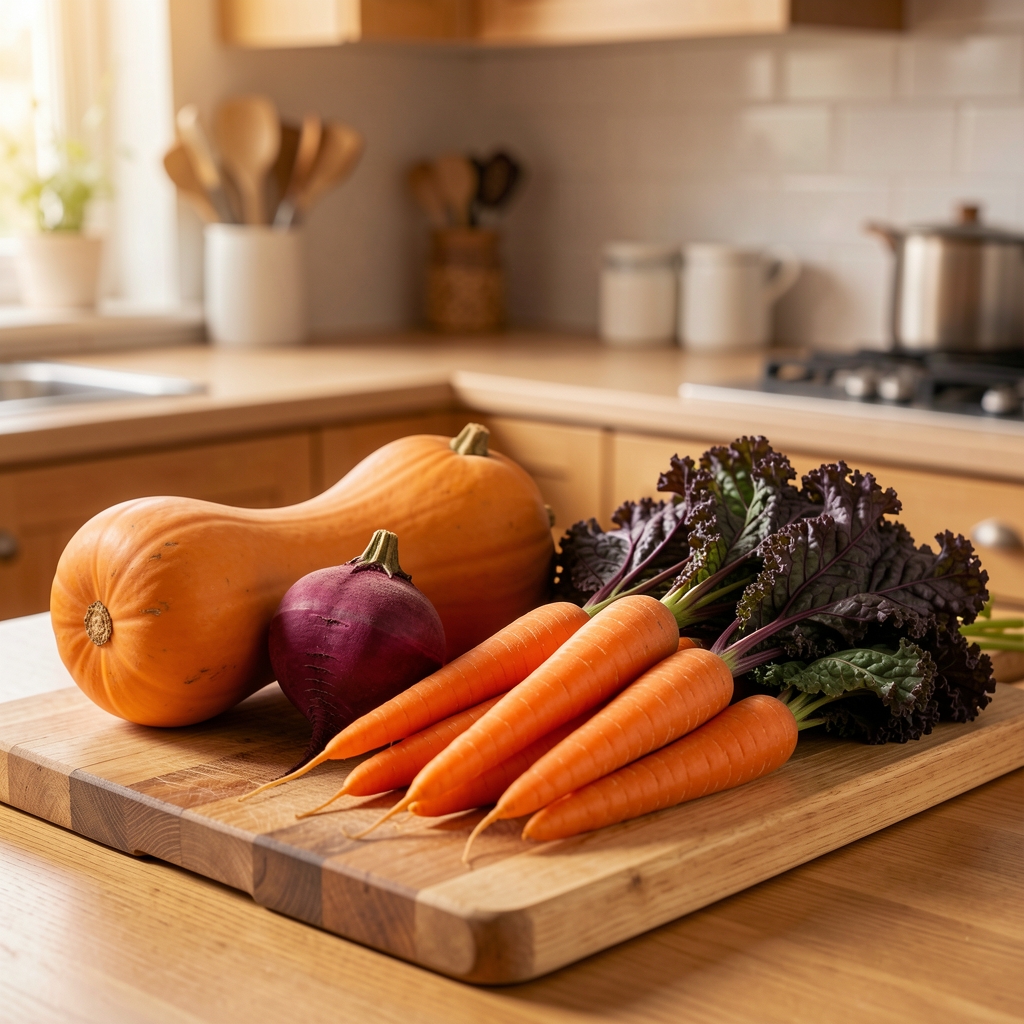
Butternut squash, pumpkin, apple, pear, blackberry, cauliflower, broccoli, fennel, carrot. Rich in beta-carotene, vitamin K, and soluble fibre.
Gut-Friendly Cooking as a Practical Discipline
The phrase "gut-friendly" has acquired a commercial register that can obscure its actual meaning. In the context of this publication, it refers to a cooking approach that prioritises high plant diversity, adequate fibre from multiple sources, and the inclusion of fermented foods where they suit the meal — not as a separate wellness intervention, but as a natural component of a varied diet.
Practically, this means building meals around a varied plant base rather than around protein as the sole focal point. A plate organised around seasonal vegetables, with protein (animal or plant-based) as one of several components, naturally tends toward higher fibre content than one built around the protein source alone.
The cooking methods also matter. Long-roasted root vegetables develop a different fibre profile than raw or briefly steamed ones. The combination of both across a week — some roasted, some raw, some lightly cooked — provides the gut microbiome with a broader set of inputs than a single preparation method throughout.
Movement, Appetite, and the Active Week
The connection between sport and fitness and nutritional practice is often discussed in terms of performance optimisation — a register that can feel remote from the concerns of ordinary daily life. But the relationship between physical activity and appetite is practical and immediate: on days of higher activity, appetite tends to increase. On sedentary days, it may be more muted.
Calorie awareness in this context is less about counting and more about attention. The active lifestyle does not require a surplus of any single macronutrient — it requires adequate energy from a mixed source, with carbohydrate from whole grains and root vegetables providing sustained energy, and protein from varied sources (legumes, dairy, fish, or meat, according to preference) supporting recovery.
Seasonal cooking aligns naturally with this: the heavier, more energy-dense foods of winter (root vegetables, legumes, grains) suit the season in which we tend to move less. The lighter, hydration-rich foods of summer (salads, fresh fruits, courgettes and tomatoes) suit the season of more varied outdoor activity. This alignment is not mystical — it is simply the accumulated common sense of many generations of people eating what was available to them.
Hydration and the Seasonal Plate
The water content of seasonal produce contributes meaningfully to daily fluid intake — a fact that the focus on drinking water alone tends to obscure. Summer fruits and vegetables (cucumber at 96% water, tomatoes at 94%, watermelon at 92%) provide substantial hydration as part of a normal meal. In contrast, winter produce — denser and lower in water content — requires more conscious attention to separate fluid intake.
Hydration habits built into the seasonal cooking rhythm might look like: a warm vegetable broth alongside winter meals, a tall glass of water with every spring salad, fresh fruit as a regular afternoon component rather than a special occasion. These small structural habits, consistent across seasons, maintain fluid balance without requiring dedicated attention.
Three Gut-Friendly Seasonal Recipes as Architecture
The following are structural sketches rather than precise recipes — templates adaptable to whatever the current season offers.
Cooked pearl barley or farro · Roasted parsnip, celeriac and beetroot · Wilted kale with garlic · Tahini and lemon dressing · Toasted sunflower seeds. Construct in layers. Eat warm.
Briefly blanched asparagus · Raw pea shoots and watercress · Soft-boiled eggs or cooked lentils · Fresh radish · Olive oil, white wine vinegar, mustard. Assemble cold. Serve immediately.
Roasted butternut squash · Cooked Puy lentils · Toasted walnuts · Wilted spinach · Pomegranate seeds · Warm spiced dressing (cumin, coriander, apple cider vinegar). Assemble warm or at room temperature.
A Closing Note on Weight and Season
The sustainable weight approach that this publication returns to across many articles is not a programme. It is a disposition toward eating that prioritises consistency over intensity, variety over precision, and enjoyment over deprivation. Seasonal cooking supports this disposition because it is inherently interesting — the kitchen changes every few months, new ingredients arrive, familiar ones depart — and because it is inherently varied.
Weight management, in the long-term sense that the published nutritional literature consistently describes, is the result of a sustained pattern of nourishment — not of any single strategy applied briefly. A diet built around seasonal whole foods, varied by the calendar, adequate in fibre and hydration, and eaten with reasonable attention to quantity, is as close to a consensus approach as the current nutritional literature offers.
It is not, it should be noted, a particularly exciting conclusion. But the quiet logic of eating well across a year — of following the season rather than fighting it — produces, over time, a kind of nutritional confidence that no short-term approach can replicate.
- 01Dietary diversity — measured by the range of distinct plant foods consumed weekly — is a meaningful indicator of gut health.
- 02Seasonal eating naturally produces higher variety across twelve months than fixed-repertoire shopping.
- 03British seasonal produce is nutritionally sufficient in all four quarters — winter included.
- 04Mixing cooking methods (roasted, raw, steamed) across the week broadens the fibre profile of the diet.
- 05Summer produce contributes meaningfully to hydration; winter eating requires more deliberate fluid intake.